
GOLDILOCKS goes sailing
Three days and 930 km off Brest, routing a high-performance catamaran through real weather. The routing model has left the simulator.
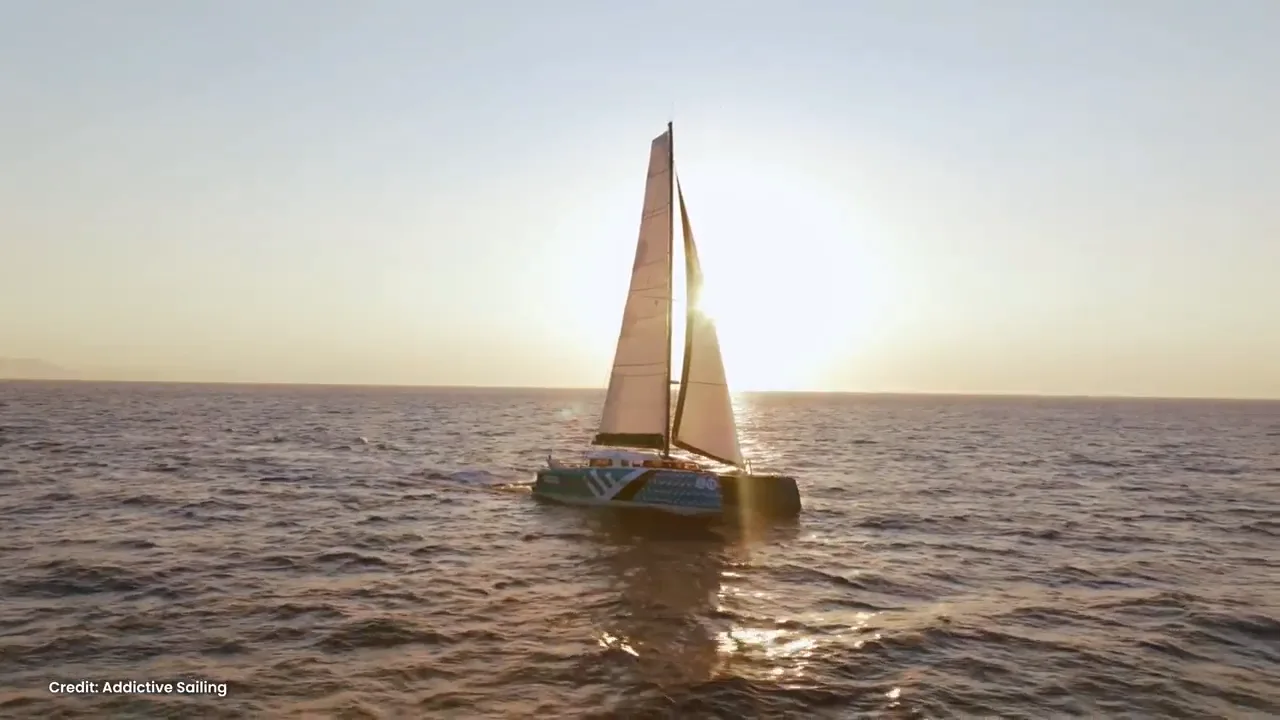
GOLDILOCKS is DRIFT's AI-enabled routing model, named for the weather it looks for: not too light, not too strong, just right. Until now it had been proven in simulation, across more than a decade of recorded weather. In September it went to sea.
Frederick Parton, DRIFT's data scientist and a professional sailor, took it aboard AVEL VAEZ, an ORC57 high-performance sailing catamaran, out of Brest. For three days the crew sailed the routes GOLDILOCKS set: through a weather front, through the night and home again.
The aim was not to race. It was to see how the model behaves when the forecast meets the real ocean, what it gets right and what the software needs next. GOLDILOCKS was developed with Faculty, and the trial's data goes straight back into it.
- 50 hours day and night
- 930 km travelled
- 11 GB of data captured
- Zero hours in bad weather
Day 1: Out of Brest and around a front
The trial left Brest on a sunny morning with a strong wind forecast. A front was due to pass, and the job was to stay clear of the worst of it without losing the wind.
“We’ve got a strong wind forecast where this front passes, so our routing will have to avoid this bad weather but also keep us in that sweet spot between being in no wind and being in strong weather.” Frederick Parton, Data Scientist at DRIFT
GOLDILOCKS kept the vessel in the stronger pressure and sent it out towards the front for the night. By midnight the breeze had built. The crew put a reef in while Freddie ran fresh routes at the nav station to time the next tack.
Day 2: Testing the workflow at sea
The second day was about the workflow as much as the route. At sea, the team could run simulations, models and time resolutions side by side, and adjust the vessel's polar speeds against how it was sailing.
“Super productive day and night of testing, the workflow is really good. We’re able to run lots of different simulations, different models, different time resolutions.” Frederick Parton
Performance matters, but the model is not racing. Its job is to predict how fast the vessel will go, because every routing decision rests on that prediction.
The rain cleared once the vessel had sailed out of the front. In 20 to 25 knots of wind, GOLDILOCKS took it towards the Isles of Scilly and back, across the water between Cornwall and Brest. A pod of dolphins kept the crew company for part of the way.
“The experiments with the routing algorithm have been very productive. We’ve learned a huge amount of things of what features to add, actually testing and validating what we’ve got so far, which for now I’m happy to say has been a really good success.” Frederick Parton
Day 3: Via Ouessant and home to Brest
Overnight the route took the crew out towards Ouessant, then back into the Bay of Brest on the third morning. GOLDILOCKS had them working back and forth, still making 10 to 12 knots.
“It’s been a super successful trip, we’ve managed to do a really nice route, we’ve kept up a very high average speed of around 10 knots, and overall just so many learnings on how to operate the software … so that it works well for a ship that’s going to be autonomous.” Frederick Parton
That average speed came from the route GOLDILOCKS set. It does not read a chart. It works from a set of performance polars: for every combination of true wind speed and angle, how fast the vessel goes and how much power it makes. Those polars are laid over a moving forecast of wind, wave and current, and the model searches for the best way through.
What the trial changes
GOLDILOCKS has now been proven at sea, not only in simulation. Over three days it routed a real vessel through a front, at an average of around 10 knots. The crew tested the workflow at sea and came home with a list of features to add, and 11 GB of data to build them.
GOLDILOCKS was developed by DRIFT with Faculty. See how GOLDILOCKS works.
Our thanks to the crew of AVEL VAEZ.